SWIG Alternatives: The Best SWIG Replacements for Modern C++ and Python Development in 2026
What Are the Best SWIG Alternatives?
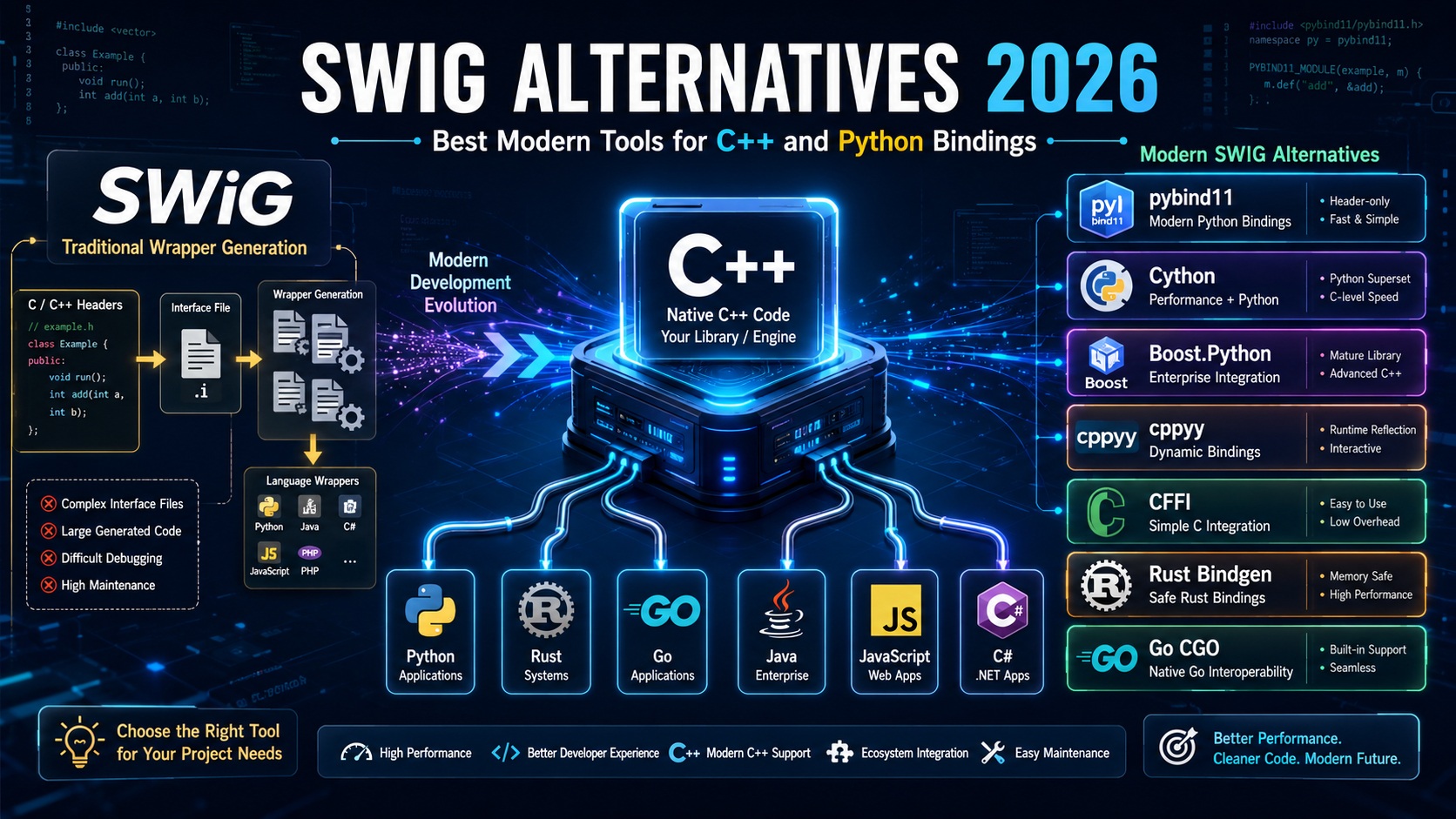
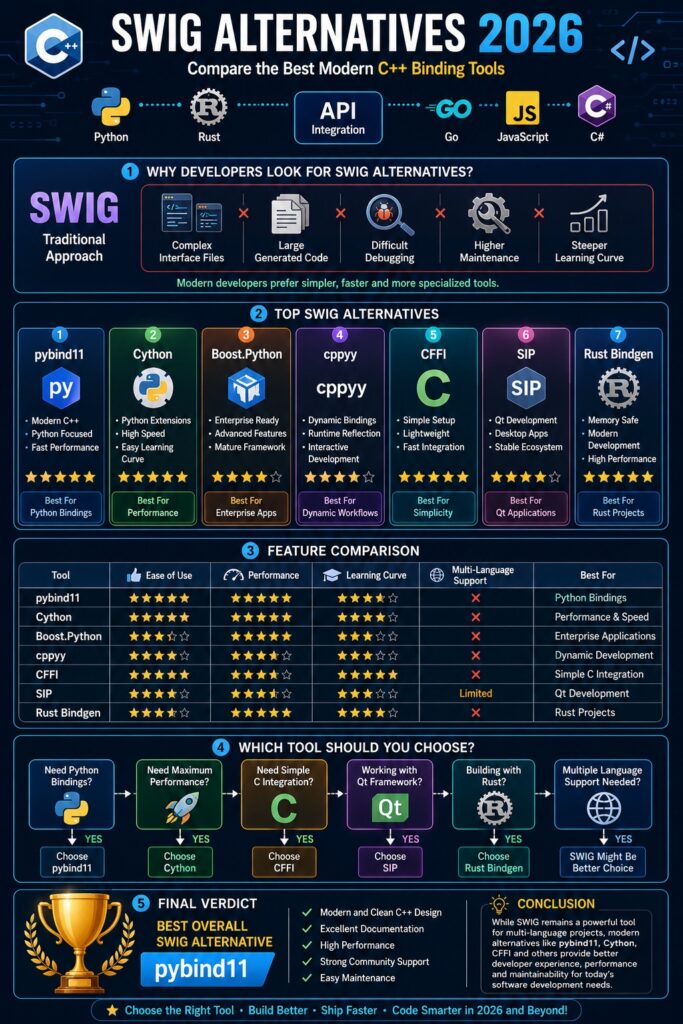
The best SWIG alternatives in 2026 include pybind11, Cython, and Boost. Python, cppyy, CFFI, SIP, Rust Bindgen, and Go CGO. These interoperability tools help developers create efficient language bindings between C/C++ code and modern programming languages while offering better developer experience, easier maintenance, and stronger ecosystem integration.
If you’re looking for a SWIG replacement for Python bindings, C++ integration, native extensions, or cross-language development, this guide covers everything you need to know.
Explore: Swig Menu With Prices 2026
Why Developers Look for SWIG Alternatives
SWIG has been one of the most widely used wrapper generation tools for decades. It allows developers to connect C and C++ libraries with multiple programming languages, including Python, Java, JavaScript, Go, Ruby, PHP, Lua, R, and C#.
SWIG became popular because it automates the process of generating bindings. Instead of manually writing glue code, developers can define interfaces and let SWIG generate wrappers automatically.
However, modern software development has evolved.
Today’s teams often focus on a single ecosystem rather than supporting many languages simultaneously. As a result, developers increasingly prefer language-specific binding frameworks that provide:
- Cleaner APIs
- Easier debugging
- Better performance
- Reduced maintenance
- Faster onboarding
- Native ecosystem integration
These factors have driven the growing demand for modern SWIG alternatives.
Explore: The Swig Hiring Age 2026
How SWIG Works
SWIG parses C and C++ header files and generates wrapper code that allows communication between native code and higher-level languages.
Think of SWIG as a translator between two systems.
Your C++ library speaks one language.
Python, Java, or Go speaks another.
SWIG handles the translation layer so both sides can communicate effectively.
This approach remains valuable for projects requiring multi-language support, but many developers find newer alternatives easier to maintain and optimize.
What Makes a Good SWIG Alternative?
When evaluating SWIG alternatives, developers typically look for:
Simplicity
Less boilerplate code and fewer configuration files.
Performance
Efficient interaction between native and managed code.
Modern Language Support
Compatibility with current C++ standards and programming ecosystems.
Active Development
Regular updates, strong documentation, and active communities.
Tooling Integration
Support for build systems such as:
- CMake
- Meson
- Bazel
- CI/CD Pipelines
Best SWIG Alternatives in 2026
1. pybind11
pybind11 has become the most popular SWIG alternative for Python projects.
Unlike SWIG, pybind11 focuses exclusively on Python bindings. This specialization makes it simpler and more powerful for Python developers.
Instead of maintaining separate interface files, developers expose classes and functions directly using modern C++ syntax.
Advantages
- Modern C++ support
- Header-only architecture
- Native NumPy integration
- Excellent documentation
- Large community
Disadvantages
- Python-only
- No multi-language support
Best For
- Python extensions
- Machine learning libraries
- Scientific computing
- High-performance Python applications
2. Cython
Cython combines Python-like syntax with C-level performance.
Developers can add optional type declarations to Python code and compile it into efficient native extensions.
Advantages
- Easy for Python developers
- Significant performance gains
- Strong scientific computing ecosystem
Disadvantages
- Python-specific
- Additional compilation process
Best For
- Data science
- Numerical computing
- Scientific applications
3. Boost.Python
Boost. Python is part of the larger Boost ecosystem and provides advanced Python binding capabilities.
It supports complex C++ structures, inheritance hierarchies, and object-oriented designs.
Advantages
- Mature framework
- Strong C++ integration
- Enterprise-ready
Disadvantages
- Steeper learning curve
- Larger dependency footprint
Best For
- Enterprise software
- Large C++ codebases
- Existing Boost users
4. cppyy
cppyy uses runtime reflection and dynamic bindings instead of traditional wrapper generation.
This approach reduces maintenance overhead and simplifies rapid development.
Advantages
- Dynamic interaction
- Reduced wrapper maintenance
- Interactive workflows
Disadvantages
- Less traditional workflow
- Runtime dependency requirements
Best For
- Research projects
- Scientific computing
- Rapid prototyping
5. CFFI
CFFI provides a straightforward method for connecting Python applications to C libraries.
Its simplicity makes it popular among developers who want quick results without managing complex binding frameworks.
Advantages
- Easy setup
- Minimal configuration
- Fast development
Disadvantages
- Primarily focused on C
- Less suitable for advanced C++ features
Best For
- Small projects
- C libraries
- Rapid integration
6. SIP
SIP is best known for powering PyQt.
It specializes in exposing C++ APIs to Python applications, particularly graphical user interface projects.
Advantages
- Excellent Qt support
- Mature ecosystem
- Production-proven
Best For
- Desktop applications
- Qt development
- GUI software
7. Rust Bindgen
The rise of Rust has introduced modern approaches to interoperability.
Rust developers frequently use bindgen and cbindgen to generate bindings automatically while maintaining Rust’s memory-safety guarantees.
Advantages
- Memory safety
- Modern tooling
- Strong performance
Best For
- Systems programming
- Security-focused applications
- Modern native development
8. CGO
Go uses CGO to communicate directly with C libraries.
Instead of relying on external wrapper generators, Go provides interoperability through built-in language features.
Advantages
- Native Go integration
- Simple workflow
- No separate wrapper framework
Best For
- Go applications
- Cloud-native services
- Backend development
SWIG vs Modern Alternatives
| Tool | Multi-Language Support | Ease of Use | Performance | Best For |
| SWIG | Excellent | Medium | High | Multi-language projects |
| pybind11 | No | High | High | Python bindings |
| Cython | No | High | Very High | Performance optimization |
| Boost. Python | No | Medium | High | Enterprise software |
| cppyy | No | High | High | Dynamic workflows |
| CFFI | No | Very High | Medium | Simplicity |
| SIP | Limited | Medium | High | Qt development |
| Rust Bindgen | Rust | High | High | Systems programming |
| CGO | Go | High | High | Go applications |
Which SWIG Alternative Is Best for Python?
For most new Python projects, pybind11 is generally considered the strongest alternative.
However, the ideal choice depends on project requirements:
- Choose pybind11 for modern C++ and Python integration.
- Choose Cython for performance-focused Python development.
- Choose CFFI for quick C library integration.
- Choose Boost. Python for enterprise-grade C++ applications.
- Choose cppyy for dynamic workflows and rapid experimentation.
Enterprise Considerations
Large organizations often evaluate:
- Maintenance costs
- Developer onboarding
- Community support
- Documentation quality
- Long-term stability
SWIG still offers a significant advantage when a project requires support for multiple programming languages simultaneously.
If your organization supports Python, Java, C#, and JavaScript clients from a single codebase, SWIG may remain the most efficient solution.
However, organizations focused on a single ecosystem frequently achieve better productivity using specialized alternatives.
How to Migrate from SWIG
A successful migration strategy typically includes:
- Identifying high-value modules.
- Migrating incrementally.
- Building automated test coverage.
- Documenting new workflows.
- Training development teams.
Avoid replacing all bindings at once. Gradual migration reduces risk and improves maintainability.
Future of Language Binding Tools
The future of interoperability tools is becoming increasingly specialized.
Developers now prefer ecosystem-focused solutions rather than universal wrapper generators.
Python developers use pybind11 and Cython.
Rust developers use bindgen.
Go developers use CGO.
This trend reflects the broader movement toward modern developer experience, simplified tooling, and language-native interoperability.
Conclusion
SWIG remains one of the most important interoperability tools ever created, but modern development practices have encouraged the rise of specialized alternatives.
For Python developers, pybind11, Cython, CFFI, and Boost. Python and cppyy often provide cleaner workflows and easier maintenance. Rust and Go developers increasingly rely on native interoperability mechanisms such as Rust Bindgen and CGO.
The best SWIG alternative depends on your language ecosystem, project goals, team expertise, and long-term maintenance requirements.
Organizations requiring multi-language support may still benefit from SWIG, while teams focused on a single ecosystem often achieve better productivity using specialized frameworks designed specifically for their development stack.
FAQs
Is SWIG still actively maintained?
Yes. SWIG continues receiving updates, bug fixes, and compatibility improvements for modern compilers and programming languages.
What is the best SWIG alternative for Python?
pybind11 is widely considered the leading choice because of its modern architecture, excellent documentation, and strong Python integration.
Does PyBind11 support languages other than Python?
No. pybind11 is designed specifically for Python bindings.
Is Cython faster than SWIG?
Cython can provide excellent performance because it compiles Python-like code into optimized C extensions.
What is the easiest SWIG alternative to learn?
Many developers find CFFI and pybind11 easier to learn than SWIG.
Should enterprises replace SWIG completely?
Not necessarily. Organizations supporting multiple programming languages may still benefit from SWIG’s broad compatibility.